Are Privacy and Decentralization the Price of EU Compliance?
Short answer: It shouldn't be. Today, it often is.
The EU now has a full rulebook for crypto. MiCA authorization became mandatory on 1 July 2026. DORA has applied since January 2025. The new AML Regulation, the AMLR, is also coming.
Anyone building a crypto product for EU users now works within it. Exchanges, wallets, payment apps, tokenization platforms, teams running their own chains. Many of them also want to stay as close to Ethereum's values and decentralized as they can.
Getting licensed is hard work, but the path is known. Decentralization turns into a long negotiation with lawyers. Privacy usually gets dropped, and often nobody decided to drop it.
Full disclosure, by decentralization I mean what Ethereum has summed up as CROPS: censorship resistance, open source, privacy and security.
In this post, I look at why that happens and how much of it we could avoid.
How privacy and decentralization get lost
No single rule bans privacy or decentralization. They get lost bit by bit.
KYC on a public ledger is a target list
Every regulated app asks for the same things. A passport, a selfie, often a utility bill. The travel rule sends your name along with every transfer between providers. That's an old story, and on its own it's manageable.
The new part is what happens when that data meets a public chain. A traditional broker knows your positions, but the public doesn't. On a public chain, the app knows who you are and everyone else sees what each address holds. Link one address to one person and the whole history is public. Forever.
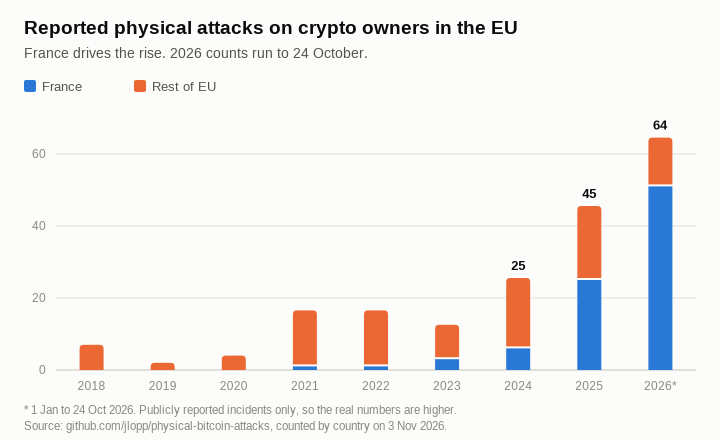
Criminals have noticed. In the first half of 2026, France's interior minister reported 77 crypto-linked kidnapping and extortion cases. Reporting on these cases keeps pointing to leaked customer data. In 2025, criminals bribed support staff at a major exchange to get exactly that.
A leaked identity next to visible holdings is a home address with a balance attached. Every extra copy of a passport makes that leak more likely.
Private DeFi gets pushed out
Users have good reasons to want private transactions. The tools exist. Shielded pools let users deposit tokens, move them privately inside the pool, then withdraw. Some wallets are starting to build these pools in, so a private send becomes just another button.
The code itself is mostly not where regulation sits. MiCA regulates service providers, not smart contracts. A non-custodial wallet that never holds user keys is usually outside it. A pool contract with no operator probably is too.
The rules apply at the regulated edges. These are the points where crypto meets a licensed business:
- exchanges and on/off-ramps
- custodians and custodial wallets
- payment providers and banks
That's where privacy runs into trouble.
- Exchanges must know where funds come from. AML guidance treats exposure to mixers and privacy tools as higher risk. A deposit that traces back to a shielded pool gets delayed, questioned or rejected.
- Custodial services can't offer anonymity. From July 2027, the AMLR Art. 79 bars them from keeping accounts that allow it. A custodial wallet can't simply add a shielded pool.
- Trading platforms can't list anonymizing assets. MiCA Art. 76(3) blocks them, unless the platform can still identify holders and their history.
So a user can be private onchain. If they try to cash out, the exchange asks where the funds came from. They can't answer without giving up the privacy they just worked for.
For builders, the line is just as blurry. A team that runs the front end, operates a relayer or collects fees may count as a service provider. MiCA leaves out services that are "fully decentralised", but never defines the phrase. If the team is a provider, its privacy feature starts to look like what the AMLR prohibits. For a small team, the safe answer is to block EU users or drop privacy altogether.
What fits the rules today is privacy that still lets the regulated party do its job. It can identify its own customer, check the source of funds and screen for sanctions. The public sees nothing. More on how to build that below.
Enterprises pay in decentralization
Enterprises get hit too, and they aren't hiding from anyone. A company is already known to its bank, its auditor and its regulator. It wants to keep investments, payroll, supplier payments and treasury moves away from competitors. That's confidentiality, not anonymity. The rules don't make that distinction, so a shielded payment from a fully identified company gets the same risk flag as a mixer withdrawal. Enterprises either stay off-chain or move to a permissioned chain run by one vendor. They get their privacy by trusting an operator. The price is paid in decentralization tradeoff instead.
DORA pulls infrastructure back to the center
DORA asks fair questions. Can you keep running if a vendor fails? Can you detect an incident and report it within hours? Who has access to what?
The fastest way to answer them on paper is often to centralize. Three shortcuts stand out.
- Network access through third-party providers. Your app needs an RPC endpoint to read the chain and send transactions. Under DORA, the company behind that endpoint is an ICT provider. If it supports a critical function, the contract must let you and your supervisor inspect how it runs. A large RPC vendor will sign that contract. Running your own nodes avoids the question, but it's 24/7 infrastructure that, other than the maintenance, also has to be documented under DORA.
- A global pause key. An admin key that can stop the whole contract makes the incident plan look strong. Something breaks, you press pause. But whoever holds that key can freeze every user's funds, at any time, for any reason. It's one key to steal and one person to pressure. While it's on, users can't leave. It also hurts the team's own position. A team that can stop the protocol looks a lot like an intermediary, which makes the "fully decentralised" exclusion harder to claim.
- Log everything. DORA asks you to detect anomalies. The quick answer is to log every request with IP and address. Self-hosted or not, that's a full map of who did what. It's also one more database to leak.
Each shortcut ticks a DORA box. Each one gives up a piece of CROPS.
Using several vendors doesn't fully fix it. DORA Art. 29 asks each firm to assess concentration risk, and two RPC vendors look fine on paper. But if every regulated app picks the same two or three, the whole ecosystem depends on them. Each firm is diversified but the network isn't.
What it could look like instead
Here's how I'd change the defaults. Some of this works today. Some of it is where I hope we end up.
Not a copy of the passport, but a proof of the fact
Today, every app runs its own KYC. You upload your passport and a selfie, and the app keeps a copy for years. The next app asks for the same again. But most checks need a fact, not a document. Is this person an EU resident? Over 18? Not on a sanctions list?
The change I'd like to see is simple. Verify once, then prove.
- A regulated party checks your passport once.
- It issues a signed credential to your wallet. e.g., "verified, EU resident, over 18".
- The next app asks your wallet. The wallet shares only the facts the app needs, or a zero-knowledge proof that they're true.
- If law enforcement needs your identity, they go to the party that verified you.
The app gets a yes that it can verify. It never stores your passport.
It seems like the EU is already building the first half. Every member state must offer an EU Digital Identity Wallet by the end of 2026. It's an app that holds your national ID as a digital credential. It can share a single fact, like "over 18", without revealing the rest. At least that's the promised theory.
The second half isn't there yet. Private companies only have to accept the wallet from late 2027. The AMLR lets one firm rely on another firm's checks. But the relying firm still has to receive the customer's identity data. It must also be able to get copies of the ID documents. And nothing says a zero-knowledge proof is enough to pass an AML check. Until that changes, the copies keep spreading.
"Not sanctioned" has an expiry date
Sanctions are the hardest fact to prove this way.
- The list changes. A credential saying "not sanctioned" goes stale the day the sanctions programs get updated and new names are added. For example, DPRK activities are at a high level these days.
- The AMLR assumes re-checks. Financial institutions must re-check on every new designation.
So a sanctions credential needs an implementation with a short expiry, or an issuer that can revoke it as soon as a new name is listed.
Not "reveal everything", but "prove your funds are clean"
Back to the user cashing out from a shielded pool. Today they either reveal everything or get rejected. Two tools already exist that avoid both.
- Association-set proofs. The user proves their withdrawal comes from a set of deposits that excludes flagged ones. They never reveal which deposit is theirs. The original paper explains the design.
- Viewing keys. The user shares a read-only key with the one venue that asks. That venue can check the history. The rest of the world still can't.
Both answer the source-of-funds question and the user stays private. A regulated app offering private balances can use the same idea. It holds the viewing key, so it can identify holders. That is the condition MiCA Art. 76(3) asks for. The public still sees nothing.
Not compliance in the protocol, but at the access points
The regulated part of a crypto product is usually its edges. The front end, the on-ramp, the off-ramp. That's where the checks belong. The contracts underneath can stay permissionless.
e.g., A team running its own L2 chain might be tempted to screen every transaction at the sequencer. That turns the whole chain into a gatekeeper, and every other app on it inherits the same policy. Checks at the team's own front end and ramps only touch the team's own users.
Not one vendor with a contract, but redundancy you can show
Each DORA shortcut above has a version that keeps CROPS intact.
- Several node sources. Run your own node plus at least two providers, with automatic failover. Ideally not the same two everyone else uses. That's a working exit plan, which is what DORA asks for.
- Verify what providers return. A light client checks chain data against consensus. A provider can go down, but it can't lie to your users.
- Trust-minimized bridges. A bridge secured by proofs has no operator to trust, but do DORA's due diligence anyway: who can upgrade it, and what breaks if it fails. In 2022 only, bridges accounted for 64% of the $3.1 billion stolen from DeFi.
- Keep IPs away from providers. Proxy or route requests so no single provider sees a user's IP next to their addresses.
- A scoped pause. Let it stop new deposits, never withdrawals. Put it behind a timelock and publish who holds it. Users can always leave.
- Log what an incident needs. Errors, latency, contract events. Not IP and address pairs. Keep a short retention period.
What still blocks builders
From the implementation side, a few things make the better path harder than it should be.
- DORA has no small-team track for crypto. The simplified regime in Art. 16 doesn't include crypto service providers. A six-person team writes the same ICT risk framework, vendor register and incident process as a large exchange.
- "Fully decentralised" has no definition. MiCA leaves these services out but never says what qualifies. DeFi teams guess where they stand.
- AML rules don't say proofs count. Until they do, every provider keeps defaulting to copies of documents.
Every shortcut adds a middleman
Look back at each problem in this post. They share one pattern.
- The KYC database is a middleman holding your identity.
- The off-ramp decides whether your private funds are acceptable.
- The permissioned chain is a vendor holding an enterprise's privacy.
- The RPC vendor, the pause key and the log store sit between users and the network.
EU rules were written for a world of intermediaries. When they meet a decentralized system, the easiest way to comply is to add one. Each new middleman is one more place where privacy leaks and CROPS breaks.
That's the real price. It doesn't come from one rule. It comes from many small shortcuts that each look reasonable on their own.
Part of the fix is on regulators. Accept proofs, define decentralization, give small teams a lighter path. Most of it is on us. Run light clients. Scope the pause. Log less. Put checks at the edges and leave the network neutral.
Privacy and decentralization don't have to be the price of compliance. Right now, giving them up is the default, and defaults can change.